
Musical mats all look similar in a catalogue photograph, and the differences that decide sell-through are invisible in one: key pitch, sensor construction, the difficulty curve of the play modes, and whether the mat slides on a wooden floor. This guide orders the selection decisions the way they actually affect cost and returns.
Two companion guides go deeper on the other two questions buyers ask: customising the mat and certifying it.
1. Start with the age band, not the feature list
Age fixes the size, the sensor spacing, the volume ceiling and the compliance route before anything else is decided.
| Age band | What the product must be | What to avoid |
|---|---|---|
| 12–36 months | Small mat, 4–6 large keys, low volume, no loose parts, wipe-clean surface | Button cells, detachable key caps, thin PVC that tears |
| 3–6 years | 6 keys, melody play plus a reflex game, mid volume, 90 × 70 cm and up | Complex menus, small text, songs with long intros |
| 6–10 years | 8 or more keys, scoring, two-player mode, difficulty levels | Infantile sound effects; this age rejects "baby" products fast |
| Family / all ages | Double mat, 2-player versus, TV or Bluetooth output | Single-player-only firmware, mats too short for an adult stride |
Age also decides the claim on the box. An "ages 3+" product can be sold with simpler warnings; a mat marketed to toddlers pulls in stricter small-parts and labelling expectations, and the listing photographs have to match.
2. Play modes: what earns repeat play
Feature lists grow because features are cheap to add in firmware and expensive to get wrong. Rank modes by how long they hold attention:
| Mode | Retention | Cost to add | Notes |
|---|---|---|---|
| Free play / piano | High for 3–5, drops after | Near zero | Must sound in tune; intonation is noticed immediately |
| Follow-the-lights sequence | Highest across ages | Low — LED and timing logic | Difficulty ladder matters more than the mode itself |
| Reflex / whack-a-key | High for 6+ | Low | Needs scoring and a visible timer to be competitive |
| Animal sounds and memory | High for 3–5 | Low | Cheap perceived value, strong on packaging |
| Two-player versus | High for siblings | Medium — bigger sensor array | Justifies a step up in price |
| Karaoke / microphone | Medium, novelty | Medium — mic, gain control | Feedback control is the engineering risk |
A 6-key mat with two well-tuned modes outsells a 24-key mat with eight shallow ones. If you must cut scope, cut key count before you cut the difficulty curve.
3. Mat construction: surface, sensor, base
| Surface | Feel | Durability | Best for |
|---|---|---|---|
| Flannel with lamination | Soft, quiet, premium | Good if laminated; pills without it | EU and US family retail |
| PEVA | Smooth, wipe-clean | Excellent | Humid markets, easy-clean claims |
| PVC | Firm, noisy | Good | Budget channels; phthalate risk in the EU |
| Foam-insert pad | Thick, arcade-like | Good; heavier | Console dance pads, not music mats |
Under the surface, three sensor approaches are common. Printed membrane contacts are the cheapest and account for most dead-arrow complaints. Carbon-film membrane layers with a spacer are the volume standard and are reliable if the spacer is uniform. Force-sensitive resistors give the best feel and per-key velocity, at roughly double the sensor cost — worth it only on a premium musical product where dynamics matter.
Also check the base: a real anti-slip coating, not printed dots. Mats that slide on laminate are returned, and no amount of firmware fixes it.
4. Power, sound and connection
- 3× or 4× AA cells. Cheapest, no transport paperwork, no charging complaints — but heavy for air freight and a steady consumable cost for the customer.
- Rechargeable 600–1,200 mAh with USB-C. Better perceived value, standard in 2026, but adds UN 38.3, an MSDS and a charge-port warranty risk.
- Bluetooth audio. Lets a parent play their own playlist, which dramatically extends the product's life. Requires RED in the EU and an FCC ID in the US.
- TV output. HDMI is the modern expectation; AV cables are still accepted in value channels. Test on cheap TVs — the pairing screen is where support tickets are born.
Whatever the power choice, specify the speaker with the acoustic limit in mind rather than the loudest part in the quotation. A 2 W driver with a proper enclosure beats a 3 W driver in a thin box that clips.
5. Channel fit
| Channel | Spec emphasis | Indicative FOB band (1,000 pcs) | Main risk |
|---|---|---|---|
| Amazon / marketplace | Bluetooth, 6+ modes, strong photography, gift box | US$11–18 | Returns from pairing and volume complaints |
| EU toy retail | EN 71 file, calm colours, German/French manuals | US$12–20 | Labelling and packaging EPR compliance |
| Discount / value chains | 4–6 keys, AA cells, simple box | US$6–9 | Margin after freight on a bulky carton |
| Gift and seasonal | Licensed-style artwork, window box, mic | US$9–15 | Container timing; 6-week selling window |
| Education / therapy | Durability, volume control, no flashing modes | US$15–25 | Spec creep and small order quantities |
The bands are indicative for 1,000 pieces FOB Shenzhen and move with key count, cell type and packaging. Use them to sanity-check a quotation rather than as a target.
6. A three-SKU ladder that covers most catalogues
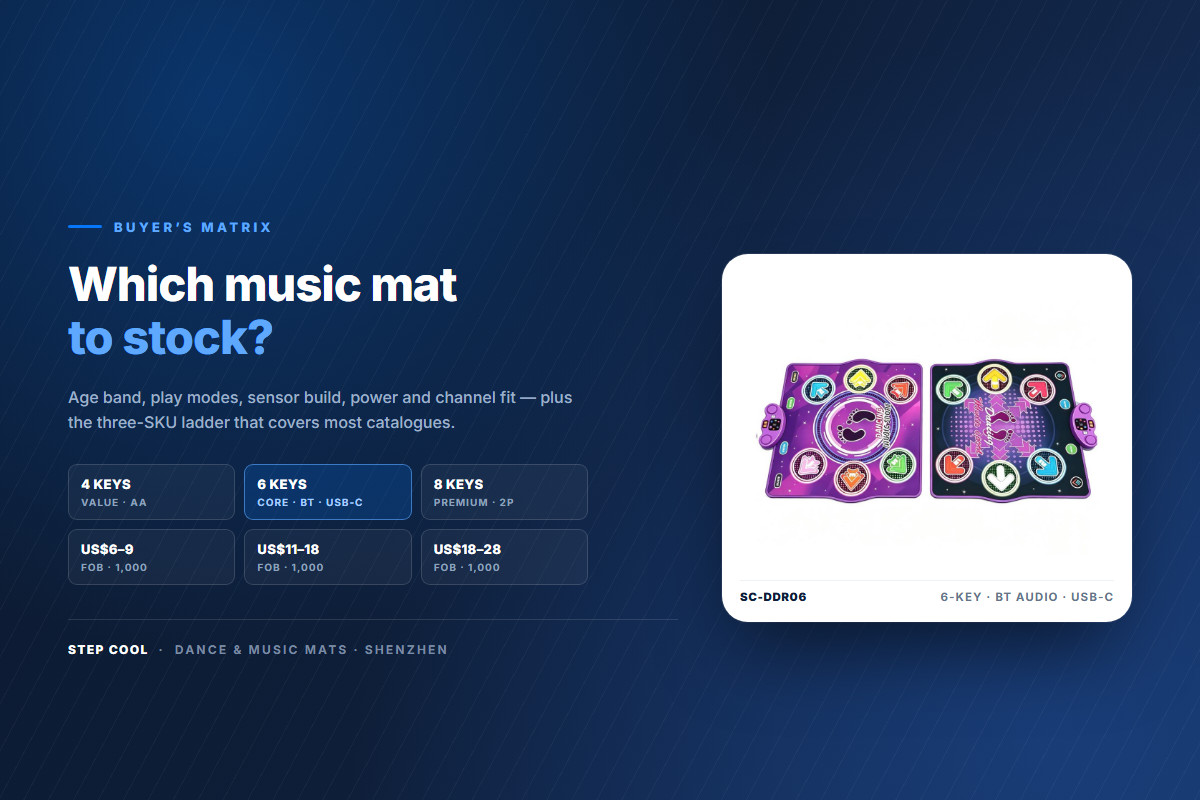
- Entry — 4-key, AA, 3 modes. Protects the price ladder, absorbs promotional pressure, minimal certification scope.
- Core — 6-key, USB-C rechargeable, Bluetooth, 6 modes including animal sounds and a memory game. This is the volume SKU in almost every market we ship to.
- Premium — 8-key or double mat, two-player, 12+ modes, gift packaging, microphone. Carries the margin and the gifting season.
One platform across three tiers is worth more than three unrelated products: shared tooling, shared test reports where the electronics are identical, and one spare-parts policy.
7. The landed-cost check most buyers skip
Mats are bulky, and bulk is the quiet margin killer. A rolled mat in a 52 × 38 × 12 cm carton at 10 units per carton consumes roughly 0.024 CBM per unit — two to three times a controller. On a US$12 FOB product, sea freight and duty can add US$3–5, and air freight can double the landed cost. Model it before you agree a retail price; the landed cost calculator will do the arithmetic including duty, inspection and returns allowance.
Two levers: ask for a vacuum-flat or rolled pack that reduces cube without creasing the print, and consolidate cartons to a full pallet rather than shipping loose.
8. The 15-minute sample evaluation
- Press every key 20 times at the edge as well as the centre, and count misses.
- Play the full song list — the last track as carefully as the first.
- Turn the volume to maximum on the densest track and listen for distortion.
- Fold and unfold along the intended crease five times, then re-test the keys.
- Put it on a hard floor and try to slide it with one foot.
- Drop the packed carton from 80 cm onto a corner.
- Time how long it takes to pair with a TV you have never used before.
- Read the manual as a parent would, and count the steps to first play.
If a sample survives that routine and a five-year-old plays with it for ten minutes without help, the product is probably right for the channel. If an adult needs the manual twice, the firmware is not finished.
Where STEP COOL fits
We manufacture both ends of this category, which makes the ladder practical: wired 4-in-1 dance mats for value and console channels, wireless TV mats with 200+ built-in songs, and the SC-DDR06 six-key light-up music mat with Bluetooth audio, a microphone input and six play modes — the SKU most buyers use as the core of a music-mat range.
Send your market, age band and target retail price. We will propose the specification that fits the price, with MOQ, carton cube and the certification list for that market.