
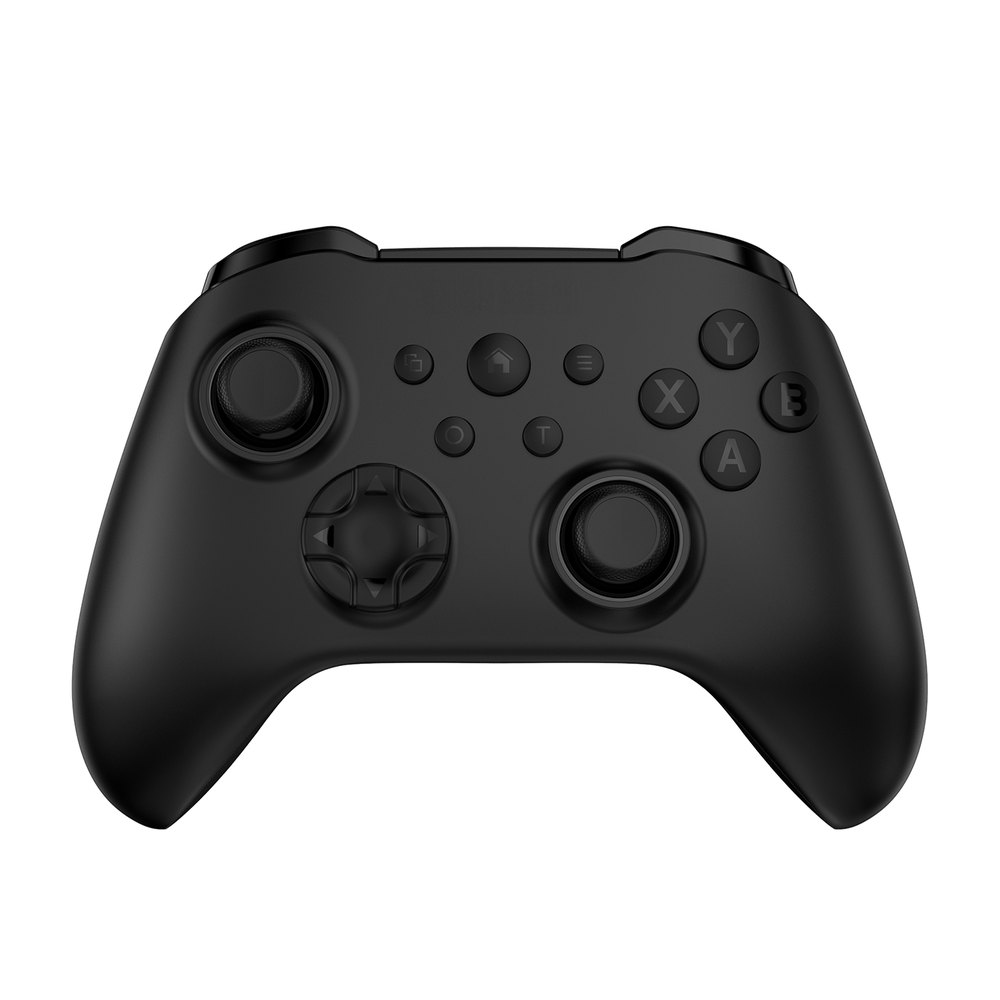
A custom controller is the fastest way for a brand to enter gaming hardware without building an engineering team. The work is real, but it is mostly decisions rather than invention: what you change, what you leave alone, and in what order to do it so that your money goes into the parts customers can see and feel.
Three levels of customisation, and what each costs
| Level | What you change | Typical MOQ | Tooling | Time to first shipment |
|---|---|---|---|---|
| L1 — Cosmetic | Logo on the shell, retail box, manual, cable label, colour accent | 500–1,000 | Printing plates only, usually under US$500 | 4–6 weeks |
| L2 — Product-level | Shell colour and finish, button feel, stick caps, trigger type, firmware config (mapping, dead zones, lighting, turbo) | 1,000–3,000 | US$1,500–5,000 depending on parts | 8–12 weeks |
| L3 — New model | Own PCB layout, new ergonomics, new radio/charging design, exclusive firmware and app | 3,000+ | US$8,000–25,000+ | 16–28 weeks |
Most successful brand launches start at L1 or L1.5, prove sell-through, then move to L2 on the second order. Jumping straight to L3 on a first order ties up capital in tooling before you know whether the market wants your brand at all.
What you can realistically customise on an existing platform
On a mature controller platform the following are usually changeable without new tooling:
- Hall Effect or TMR sticks instead of potentiometer sticks — no drift, typically rated 5,000,000 cycles versus roughly 1–2 million for cheap potentiometers. This is the single most valuable upgrade for a premium positioning.
- Stick caps and tension, D-pad shape, button travel and actuation force.
- Trigger architecture — linear Hall triggers with 256-level resolution, micro-switch triggers for instant response, or a switchable dual-body design that gives both.
- Back buttons and paddles, with or without macro recording.
- Polling rate — 1,000 Hz wired and wireless is now the expectation for a competitive brand; 125 Hz reads as a budget product.
- Lighting — RGB zones, presets, brightness and effect modes.
- Connectivity set — wired USB-C, Bluetooth, and a 2.4 GHz dongle, with the mode switch logic you want.
- Battery and charging — cell capacity, charge time, whether a dock is included.
- Firmware configuration — button mapping, dead zones, vibration curve, gyro on/off defaults, turbo behaviour.
- Companion app — if the platform already has one, you can usually get it white-labelled rather than built.
- Packaging and accessories — cable length and connector, dongle storage, carry case, quick-start card.
What is not realistically changeable on a short timeline: the wireless chipset, the console compatibility set, and the fundamental shell ergonomics. Treating those as fixed is what keeps an L2 project inside three months.
The certification chain you inherit
When you put your brand on a controller, you become the manufacturer of record in the eyes of the regulator. The certifications that matter:
- FCC Part 15B and 15C for the US — unintentional and intentional radiators. The 2.4 GHz and Bluetooth radios each need their own approval, and a new radio module means a new test.
- CE marking with EMC and RED (Radio Equipment Directive) for the EU, plus a Declaration of Conformity you sign.
- UKCA if you sell into Great Britain, separate from CE.
- RoHS and REACH SVHC, plus Proposition 65 for California.
- UN38.3 and an MSDS for the lithium cell, and a battery directive compliance statement for the EU.
- WEEE and packaging registrations in the EU, and EPR numbers in Germany and France — these are seller obligations, not factory obligations, but the factory's packaging spec feeds them.
- IFU and safety instructions in the languages of each market, in the manual and often on the retail box.
Ask your supplier for the CB/CE/FCC reports on the existing platform, then ask which of them need re-testing because your changes affect them. Cosmetic changes usually need nothing new; a new radio module or a new battery always does.
Timeline for a realistic L2 project
- Week 0–1: NDA, requirements brief, platform selection, quote with tooling and MOQ.
- Week 1–2: artwork and packaging proofs, firmware configuration sheet signed off.
- Week 2–4: T1 sample — first physical unit with your cosmetics and firmware config.
- Week 4–6: T2 sample after your feedback, plus certification testing kicked off.
- Week 6–8: golden sample approval, packaging pilot, deposit paid, production slot booked.
- Week 8–11: mass production, in-line test, your inspection.
- Week 11–12: balance payment, shipment, documents.
The two things that most often add two weeks each: late artwork revisions after T1, and a changed radio module discovered during certification. Freeze the artwork before T1 and confirm the radio module on day one.
Cost drivers, ranked
- Sticks. TMR or Hall Effect sticks cost more per unit than potentiometers but remove the number-one warranty complaint.
- Trigger architecture. Dual-body switchable triggers are the most expensive mechanical part in the list.
- Radio and polling. 1,000 Hz wireless needs a better MCU and a better antenna layout — it is not a firmware flag.
- Battery. Capacity and certification cost scale together.
- Lighting. RGB zones are cheap in parts and expensive in assembly and in defect risk.
- Packaging. Matt lamination, foil, magnetic closures and inserts add cost faster than most buyers expect.
- Included accessories. Cables, docks, cases and cards are individually cheap and collectively significant.
Sample and acceptance criteria
Write the acceptance criteria into the PI, as measurements:
- Stick drift: zero reported drift after a 200,000-cycle automated rotation test on 10 units.
- Latency: measured end-to-end input latency at or below your stated figure, wired and wireless.
- Buttons: 1,000,000 actuation cycles without a missed or double input on the sample set.
- Battery: stated hours at 50% volume with lighting on, measured, not calculated.
- Radio: no dropouts at 8 metres line of sight and 5 metres through one wall.
- Drop: 1.2 m packaged drop, six faces, no functional failure.
- Cosmetics: colour within your approved delta-E tolerance against the golden sample.
How STEP COOL runs OEM controller projects
We manufacture gaming controllers in Shenzhen and have done since 2004, with TMR and Hall Effect stick platforms, dual-body switchable triggers, 1,000 Hz wired and wireless polling, and a configurable companion app. We support L1 to L3 projects, provide the certification report set for your market, and build the acceptance criteria above into the PI rather than leaving quality to adjectives.
Our current flagship platform, the SC-Q34U, is a good starting point for an L1 or L2 project: dual TMR sticks, 1,000 Hz polling wired and wireless, switchable dual-body triggers and a 4-mode platform switch. Send us your target market, quantity and the features you want to change, and we will come back with an MOQ, tooling quote and timeline.