
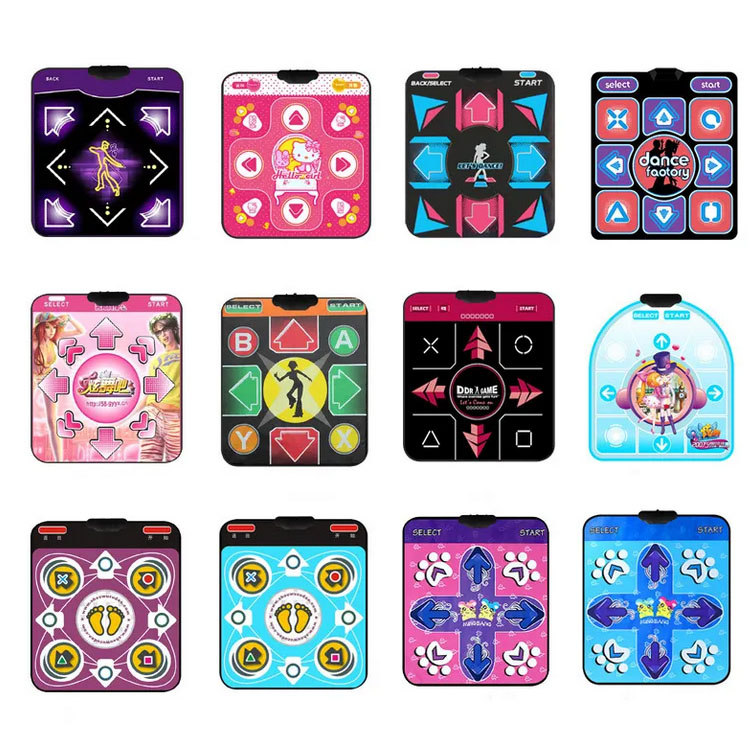
Buying dance mats for retail is a different business from buying controllers. The pad is large, the surface is soft, the electronics are embedded in fabric, and the end user is often a child. That combination makes supplier selection the single biggest factor in whether the product sells through or comes back as returns.
This guide covers the seven questions that separate a real dance mat manufacturer from a trading company, the documents to request before you pay a deposit, and how to test a sample so that the problems show up in your office rather than in your customer's living room.
1. Are they a manufacturer or a trading company?
Most "dance mat suppliers" on B2B platforms do not own a production line. They buy finished mats from a factory and resell them. This matters because trading companies cannot:
- Change the mat surface, thickness, or foam density for you.
- Modify the song library or the game firmware.
- Control the shockproof packaging that decides whether the pad arrives folded or cracked.
- Give you an honest answer about lead time, because they are quoting someone else's queue.
- Fix a defect batch, because they did not make it.
Ask directly for the factory address and a video call of the production line, not a photo gallery. A real manufacturer will show you the cutting table, the fabric lamination, the PCB assembly and the ageing test bench. A trading company will send a catalogue.
Also check the business scope on the business licence — it should say manufacturing, not only trading or import/export. A trading company with a "manufacturing" line added in 2024 is usually still a trading company.
2. Do they actually make the fabric and the electronics, or only assemble?
A dance mat is four supply chains in one product: fabric lamination, foam/sensor layers, flexible PCB and control electronics, and the game console plus song library. Very few factories own all four. What you want to know is which layers are made in-house and which are outsourced — because outsourced layers are where quality drifts between batches.
For a family/kids dance mat the highest-risk layers are, in order: the sensor layer (dead zones and stuck arrows after a few hundred hours), the fabric surface (pilling and allergy complaints), and the console firmware (song library, voice prompts, game balance). Ask which of these three are in-house.
3. Which safety and compliance documents can they provide?
Dance mats sold to families are toys in most jurisdictions, and toy rules are stricter than general electronics rules. Depending on your market you will be asked for some or all of:
- EN 71-1 / EN 71-2 / EN 71-3 — mechanical, flammability and heavy-metal migration, required to sell to EU retailers.
- CE documentation (EMC + LVD, or the Toy Safety Directive route) plus a signed EU Declaration of Conformity.
- CPSIA children's product certificate and, for the US, a CPC based on third-party lab testing at a CPSC-accepted lab.
- ASTM F963 for the US toy standard, and CPSIA Section 101 lead and phthalate limits.
- Phthalate and azo dye test reports for the flannel surface and the printed graphics.
- RoHS and REACH SVHC for the electronics and the plastics.
- UN38.3 and an MSDS if the console contains a lithium cell — and an air-freight declaration if you ship by air.
Request the PDFs with the report number and the lab name, then verify the report number with the lab. A screenshot of a certificate is not a certificate.
4. What are the real MOQ, tooling and sample terms?
Typical numbers for dance mats, so you can tell whether a quote is realistic:
| Item | Typical range | Notes |
|---|---|---|
| MOQ, existing model with your logo | 500–1,000 pcs | Below this, unit cost usually rises sharply |
| MOQ, custom colour / custom packaging | 1,000–3,000 pcs | Driven by the print run and the tooling |
| MOQ, new mould or new sensor layout | 3,000+ pcs | Ask for the tooling amortisation model in writing |
| Tooling / mould cost | US$0 – 3,000 | Often refundable or amortised against a volume commitment |
| Sample lead time | 5–10 working days | Existing model, no customisation |
| Custom sample lead time | 15–25 working days | New artwork, packaging or firmware |
| Production lead time | 25–45 days | After deposit and artwork approval, not after the PO |
| Payment terms, first order | 30% deposit / 70% before shipment | Terms improve only after a few clean orders |
Two phrases to watch for. "Tooling free" almost always means the tooling cost is priced into the unit cost, so you pay it again on every reorder. "Sample free" usually means you still pay the courier, and that you are being sent a stock unit rather than one from the production line you will actually receive.
5. How should you test the sample?
A sample that works for ten minutes in an office tells you almost nothing. Run a short, structured test:
- Drop test the packaged unit from the height your carrier will use, three times on each of three faces. Dance mats fail at the console connector and at the seam, not in the middle.
- Step test every arrow for 200+ presses and log misses. Then test at the corners and at the seams between arrows — that is where the sensor layer is weakest.
- Flex test the whole mat 30 times, folding and unfolding along the same crease a customer would use.
- Heat and cold: 4 hours at 45 °C and 4 hours at 0 °C, then repeat the step test. Flannel stiffens and PVC gets brittle.
- Wash or wipe test depending on how you will instruct the customer to clean it, then re-run the step test.
- Firmware test: play the full song list, check the last songs as carefully as the first, and confirm volume range, voice prompts and language options.
- Packaging test: ship one sample to yourself by the cheapest realistic method. Check corners, the colour box and whether the mat has taken a permanent crease.
6. What will actually cause returns?
From the field, the return drivers for dance mats are consistently:
- Stuck or unresponsive arrows after a few weeks — sensor layer or connector quality.
- Console will not pair with the customer's TV, or the HDMI/AV output does not match the TV's input mode.
- Fabric pilling and odour — cheap flannel without a lamination barrier.
- Song library feels dated or tiny — this is a firmware and licensing question, not a hardware question.
- Mat slides on hard floors — the base needs a real anti-slip backing, not printed dots.
Put these into your purchase order as measurable acceptance criteria rather than adjectives. "Zero stuck arrows in a 200-press-per-arrow test on 20 units" is enforceable. "Good quality" is not.
7. What should the contract and documentation include?
Before the deposit, get: a signed PI with the exact model and firmware version, the artwork proof, the packaging dieline, the acceptance criteria above, the compliance document list with report numbers, the spare-part terms, and the warranty and defect-handling process including who pays return freight on a defective batch.
For reorders, insist on the same model code plus a batch record. A supplier who quietly changes the sensor supplier between batch 1 and batch 3 without telling you is the single most common cause of "it was fine last time" complaints.
Where STEP COOL fits
STEP COOL has been manufacturing gaming accessories in Shenzhen since 2004, and dance mats are one of our two core lines. We make the sensor layer and the control electronics in-house, we print and laminate our own mat surfaces, and we will send production-line samples rather than stock units on request. Our dance mat range covers single and double wireless pads for TV with built-in song libraries, plus wired 4-in-1 pads for PS / Xbox / Wii / PC.
If you are sourcing dance mats and want a straight answer about MOQ, tooling and lead time, send us your target market, quantity and any artwork you already have — we will reply with a quote and a compliance document list for your market.