
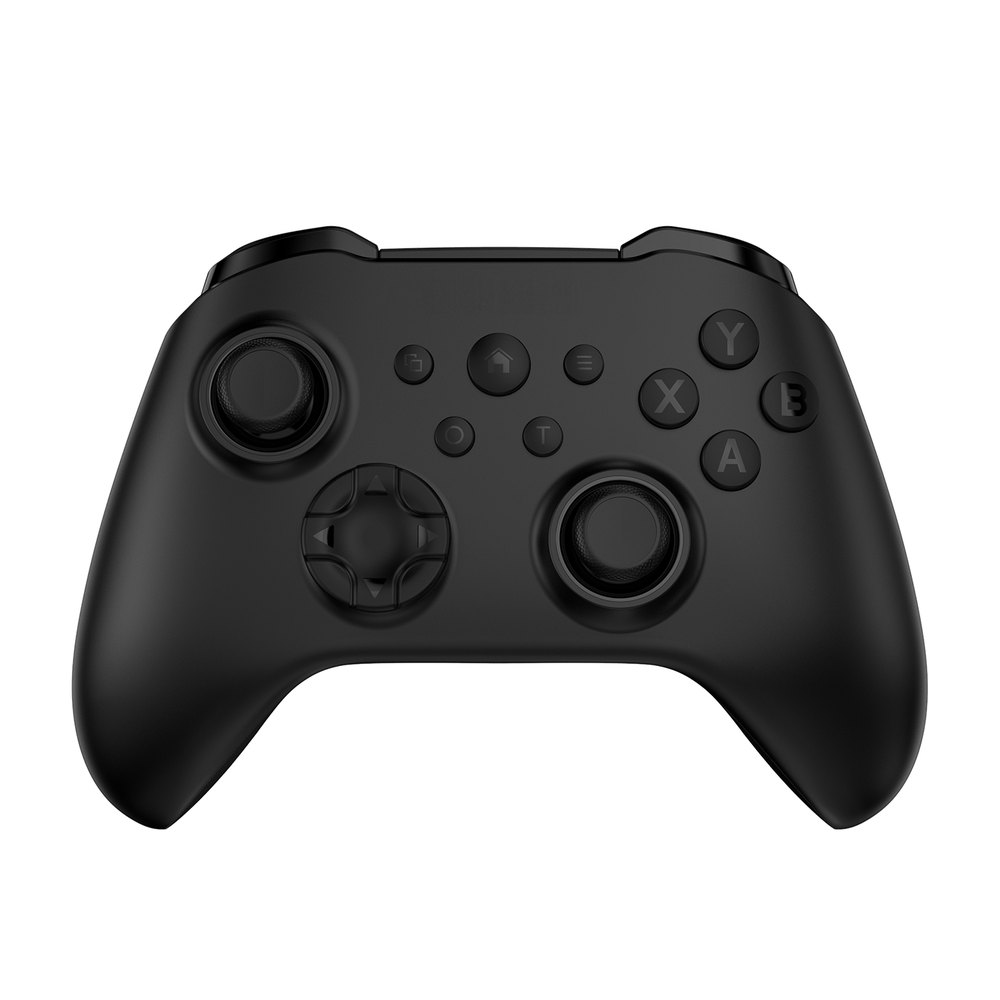
Both Hall Effect and TMR sticks exist to solve the same problem: mechanical potentiometers wear out and drift. They do it with different physics, and the difference shows up in resolution, power draw and price rather than in marketing slides.
Why potentiometer sticks fail
A conventional stick uses a wiper arm sliding across a carbon track. Every movement removes a little carbon and deposits a little debris. After a few hundred thousand cycles the resistance curve is no longer linear, the centre point shifts, and the game reads an input when the stick is at rest. That is drift, and it is not repairable by recalibration — the track has physically changed.
Typical life for a cheap potentiometer stick is around 1–2 million cycles, and drift often starts appearing well before the rated figure. This is why stick drift dominates controller warranty claims.
Hall Effect sticks: magnetic sensing, no contact
A Hall Effect stick puts a magnet on the moving part and a Hall sensor on the PCB. When the stick moves, the magnet moves, and the sensor reads the changing magnetic field. Nothing touches, so nothing wears.
- Lifespan: commonly rated 3–5 million cycles, limited by the mechanical gimbal rather than the sensor.
- Drift: effectively eliminated as a wear mechanism. Residual variation comes from magnet placement and calibration, not from use.
- Power: continuous sensing current, so slightly higher consumption than a potentiometer, though small in absolute terms.
- Resolution and linearity: good, and stable over temperature after calibration.
- Cost: moderate premium over potentiometer.
TMR sticks: the same idea, a better sensor
TMR (tunnelling magnetoresistance) uses a magnetic tunnel junction whose resistance changes far more sharply with the field than a Hall element's output does. In practice that means a larger signal for the same movement, with less noise.
- Lifespan: the sensor itself is not the limiting factor, so manufacturers rate TMR sticks at 5,000,000 cycles or more based on the mechanical assembly.
- Resolution: higher effective resolution and better signal-to-noise, which matters for the fine aim corrections that competitive players feel.
- Power: typically lower sensing current than a Hall element for the same resolution, because less amplification is needed.
- Temperature stability: generally stronger, which reduces the slow centre-point shift that some players notice after a long session.
- Cost: the highest of the three, and the supply is more concentrated.
Side-by-side
| Attribute | Potentiometer | Hall Effect | TMR |
|---|---|---|---|
| Contact wear | Yes — sliding wiper | None | None |
| Typical rated life | 1–2 million cycles | 3–5 million cycles | 5 million+ cycles |
| Drift as a wear failure | Common | Eliminated | Eliminated |
| Effective resolution | Adequate | Good | Best |
| Signal-to-noise | Noisy at end of life | Good | Best |
| Sensing current | Lowest | Higher | Moderate |
| Temperature stability | Poor | Good | Best |
| Relative unit cost | Lowest | Moderate | Highest |
Which should you specify?
- Budget or kids' products: a good potentiometer stick is still a legitimate choice if the price point demands it. Specify the rated life and the drift criterion in the PO so you know what you are buying.
- Mainstream retail brand: Hall Effect is the right default. It removes the dominant warranty complaint at a premium that the retail price can absorb.
- Competitive or premium positioning: TMR. Higher resolution and better stability are the parts of the spec a serious player can actually feel, and "dual TMR sticks" is a claim that reads strongly on packaging.
Get the rest of the spec right, or the sticks will not save you
A premium sensor on a weak platform still produces a poor controller. Four things to specify alongside the stick:
- Polling rate. 1,000 Hz wired and wireless is the current expectation at the premium end; 125 Hz reads as budget.
- Anti-drift mechanics. Specify the ring material — POM rings reduce the friction and play that produce apparent drift even with a perfect sensor.
- Calibration in production. Each unit needs its centre point calibrated on the line. Ask how, and ask for the residual error figure.
- Trigger architecture. Pair a good stick with linear Hall triggers or switchable dual-body triggers, otherwise the stick is the only premium part on the product.
Acceptance criteria to write into the purchase order
- Zero reported drift after a 200,000-cycle automated circular movement test on 10 sample units.
- Centre-point deviation within a stated count value after the test, measured, not asserted.
- Stated total rotation life with the test method named.
- Calibration residual error per unit, with the test fixture described.
- Dead zone configurable in firmware, and configurable by the end user in the companion app.
What STEP COOL uses
Our flagship SC-Q34U uses dual TMR sticks rated at 5,000,000 cycles with POM anti-drift rings, dual 1,000 Hz polling wired and wireless — 0.001 s latency — alongside switchable dual-body triggers that give both 256-level linear Hall precision and a crisp micro-switch. That combination is what we recommend for a premium brand: TMR sticks, POM rings, high polling, and a trigger that satisfies both racing and shooting players.
If you are specifying a controller range and want the stick, trigger, polling and calibration specs benchmarked against your price point, send us your target retail price and market and we will send the option matrix with the unit-cost delta for each upgrade.