
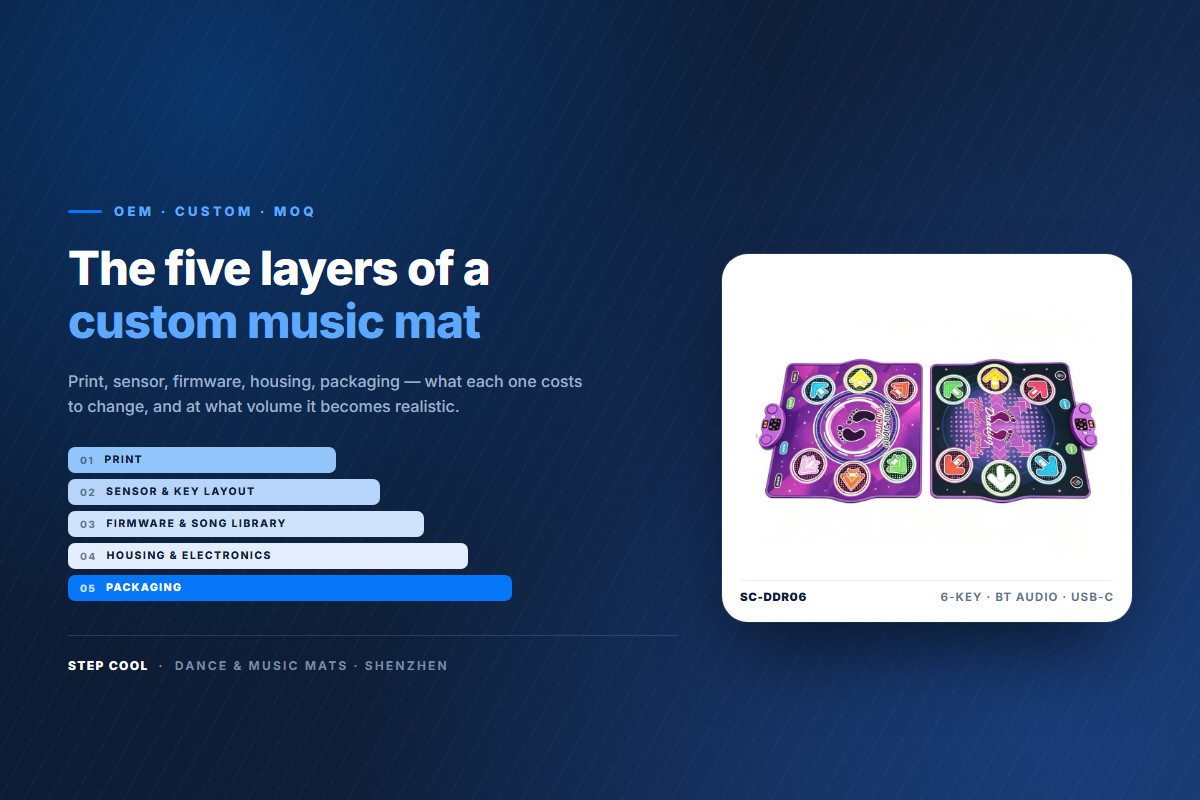
A musical mat looks like a printed floor cloth with a speaker in it. In production it is five separate pieces of engineering — the print, the sensor layer, the control board with its audio and radio, the firmware that sequences the play modes, and the packaging that has to survive a courier. Each layer is customisable, each one moves the price and the MOQ differently, and each one fails in a different way.
This guide is for brand owners and importers who already know they want a music mat and need to know what is realistic to change. If you are still deciding between mat types, start with the musical mat buyer guide; if you are mapping the certification path, read musical mat compliance.
1. The five customisation layers
| Layer | What you can change | Realistic MOQ | Lead-time impact |
|---|---|---|---|
| Print / surface | Artwork, Pantone colours, key icons, brand mark, mat size | 500–1,000 pcs | +7–10 days for a new print screen or cylinder |
| Sensor & key layout | 4, 6, 8 or 24 keys; key pitch; single or double player | 1,000–3,000 pcs | +15–20 days; may need a new die |
| Audio & firmware | Song list, voice prompts, volume curve, play modes, difficulty ladder | 1,000 pcs | +10–15 days for a build and sound review |
| Housing & electronics | Control box shape, speaker, cell type, Bluetooth, microphone input | 2,000–3,000 pcs | +20–30 days if a new mould is involved |
| Packaging | Colour box, window, inserts, manual, multi-language, retail stickers | 1,000 pcs | +7–12 days for a new dieline |
The mistake to avoid is treating these as one decision. A buyer who says "I want a custom music mat, 500 pieces" is asking for five changes on a 500-piece budget. Decide first which layer carries your brand — usually the print and the packaging — and keep the rest on an existing platform for the first order.
2. Key layout: the decision that fixes everything downstream
Key count drives the print, the sensor die and the firmware, so it is the least negotiable item once tooling is cut. What each layout is actually for:
- 4 keys / 4 arrows. The dance-mat layout. Works with reflex and memory games, cheap, and the default for discount-channel TV mats.
- 6 keys. The musical layout — enough for a playable melody across two octaves plus a jump or spin key. This is the sweet spot for ages 3–6: a melody is recognisable, and the mat is still large enough to be a physical game.
- 8 keys. One octave plus a dance ring. Higher perceived value, better for gift retail, more sensor channels and a bigger print area.
- 24 keys / full piano. A floor piano rather than a dance mat. Different buyer, different price aisle.
Two layout details decide whether the mat feels good in the hand: key pitch (centre-to-centre distance — below roughly 110 mm adults miss keys constantly) and the offset between a printed key and its sensor pad. A printed key that is visibly out of register with the sensor is the most common complaint on custom mats, and it comes from redrawing the print without re-checking it against the sensor die.
3. The song library, and the licensing trap
This is where custom music mats most often go wrong, and it is not a manufacturing problem — it is a rights problem.
Your options, in ascending order of risk:
- Original or commissioned tracks. A composer delivers 8–20 short loops for a one-off fee and you own the master. Cleanest for private label, and the only option that survives later video or influencer content.
- Public-domain melodies, new recordings. Nursery rhymes and traditional tunes are free to arrange, but the recording is not. Commission or synthesise it; do not lift an MP3 from a demo unit.
- Licensed catalogue. Possible, but per-unit royalties and territory limits make the accounting heavy below roughly 50,000 units.
- "Whatever is already in the supplier's demo." This is how importers end up with a takedown notice on a marketplace listing. If a supplier cannot say where the audio came from, assume it is not cleared.
Put three things in the purchase order: the exact audio file list with a version or hash, a written warranty that the supplier holds the rights to those recordings, and an indemnity clause naming your company. Asking whether the same song set is being sold to your competitor is a commercial question rather than a legal one — but ask it, because an exclusive song set is one of the few genuinely defensible differentiators left in this category.
4. Firmware: the layer buyers underestimate
Firmware decides whether the mat is still fun on day two, and it is the cheapest layer to change — engineering time, not tooling. What to specify:
- Play modes and their difficulty curve. Challenge, free play, sequence memory, single-key training, two-player versus. Write down what happens at level 1, at level 10 and at the top level; "progressive difficulty" is not a specification.
- Voice prompts in the market's language. Native-speaker review, not machine translation. Count the prompts, approve the audio files line by line — a 20-minute task that prevents a full rework.
- Volume at power-on. Default to a mid setting, never maximum. Parents notice, and it keeps the product inside the acoustic limits described below.
- Idle and sleep behaviour. Auto-off after 3–5 minutes without input protects the cell and removes a common warranty complaint.
- Wireless behaviour. Pairing name (put your brand in it), reconnection after power-up, and what happens when a phone call interrupts playback.
- Microphone path, where fitted — gain, feedback suppression, and whether the mic mixes with the backing track.
Ask for the firmware version to be printed in the battery compartment or shown on the setup screen. Without a version number you cannot tell batch 1 from batch 3, and every future service question becomes guesswork.
5. Sound: design to the limit with margin
Music mats are toys in most markets, so loudness is a regulated property rather than a marketing one. In the EU, EN 71-1 measures emission sound pressure at 50 cm: table-top and floor toys are limited to 80 dB(A) for exposure category 1, 85 dB(A) for category 2 and 90 dB(A) for category 3, with a C-weighted peak of 110 dB(C). Close-to-the-ear toys are far stricter at 60/65/70 dB(A).
The practical consequence for a custom build: set the maximum-volume target roughly 5 dB below the applicable limit with a fresh cell installed, then test the worst-case track — usually a dense mix with heavy low end, because harmonic distortion rather than the nominal speaker rating is what pushes the peak over. A cheap 3 W driver pushed into clipping fails where a well-matched 2 W driver passes, and the BOM difference is small.
6. Surface print: what survives a floor
Music mats are printed on flannel (soft, quiet, premium feel, needs a lamination barrier), PEVA (wipe-clean, brightest colour, best for humid markets) or PVC (cheapest, heaviest, and increasingly refused by EU buyers on phthalate grounds). Whichever base you choose, four print details decide perceived quality:
- A white base coat under the graphics. Without it colours go muddy on a dark base and the mat looks second-hand by month two.
- Ink chemistry. Phthalate-free and heavy-metal-free inks, with a test report for the printed surface — not only for the raw fabric. The print is what the child touches.
- Rub and crock resistance. Specify a rub test and a cycle count; without it your logo walks off the mat within a month.
- Registration to the sensor. Approve a printed sample on the actual sensor die, not a flat proof.
7. Packaging, manual and retail readiness
For a mat, packaging is a structural product. It has to survive being folded around something that wants to unfold, and it has to sit on a shelf without bowing. Specify a colour box with either a die-cut window or a printed mat image (windows cost more and scuff in transit), a corrugated insert that holds the mat flat, a manual in every language you sell in, and barcode or marketplace labels applied in-line rather than at the warehouse.
Add two things that cost almost nothing: a QR code on the box linking to a 60-second setup video, and a fold diagram printed inside the lid. Both cut the two most common support tickets — "it will not pair with my TV" and "I cannot fold it flat again".
8. MOQ, tooling and timeline
| Configuration | Typical MOQ | Tooling | Sample → shipment |
|---|---|---|---|
| Stock model, your logo on the box | 500 pcs | none | 5–10 days sample, 25–35 days production |
| Custom print + custom box | 1,000 pcs | US$0–500 print plates | 12–18 days sample, 30–40 days production |
| Custom firmware + song set | 1,000–2,000 pcs | engineering only | +10–15 days for build and audio approval |
| New key layout / new sensor die | 2,000–3,000 pcs | US$1,500–3,000 | 20–25 days sample, 40–50 days production |
| New housing mould for the control box | 3,000+ pcs | US$3,000–8,000 | 25–30 days sample, 45–60 days production |
9. The approval workflow that prevents rework
Custom mats fail at the handover points, not on the line. Four sign-offs, in this order, each on a physical artefact:
- Artwork proof on the real substrate — not a PDF. Approve colour against a Pantone chip in daylight.
- Audio and voice-proof pack — one folder of numbered files plus a script sheet, approved line by line.
- Golden sample, signed and dated, one kept by you and one by the factory. Everything afterwards is compared to it.
- Pre-production sample from the actual line, packed in the final packaging, before the balance payment.
Then convert the adjectives in your PO into numbers: zero missed presses in a 200-press-per-key test across 20 units, a print registration tolerance in millimetres, a maximum sound pressure at full volume, and a carton drop test height.
Where STEP COOL fits
We build musical mats on our own sensor and audio platforms, which is what makes small custom runs practical: print, song set, voice prompts and packaging can change without cutting new tooling. The SC-DDR06 six-key light-up mat — six play modes, nine built-in tracks, Bluetooth audio for a parent's playlist, a microphone input and an animal-sound memory game — is the platform most custom music-mat projects start from, alongside the rest of our dance mat range.
Send your target age band, market, quantity and any artwork you already have. We will reply with the layers we can change at your volume, a tooling and MOQ breakdown, and the test list for your market.