
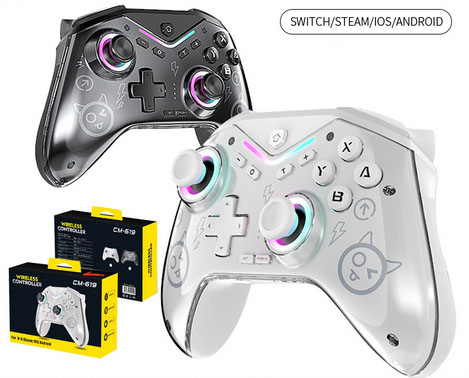
Wholesale controllers look like an easy category until you work out that you have bought three pallets of a model that only fits a console generation now in its final year. Getting the product mix and the landed cost right matters more here than driving the unit price down another thirty cents.
Start with the channel, not the product
The channel decides almost everything else — packaging, certifications, presentation and returns budget.
| Channel | Packaging need | Certification focus | Returns risk |
|---|---|---|---|
| Amazon / marketplace | Printed colour box, FNSKU label, no price on box | FCC, CE, RoHS, battery and Prop 65 | Highest — no-touch returns |
| Independent retail | Printed colour box with barcode and price space | CE, RoHS, WEEE registration in the EU | Moderate |
| Distributor / regional wholesale | Brown box or plain colour box, master carton dominant | CE, RoHS, GB standards if China-facing | Lowest — but terms are tight |
| Own-brand DTC store | Unboxing-grade packaging, inserts, quick-start card | CE / FCC plus country registrations | Moderate, high review sensitivity |
| Bundle / accessory kit | Poly bag or slim box inside a bundle | Follows the bundle | Low |
A colour box adds roughly US$0.40–1.20 per unit depending on size and finish. On a marketplace where the listing photos are all the customer sees, that is worth paying. On a container going to a distributor's warehouse, it is often money you can keep.
Building a product mix that does not go stale
Controller demand splits into three roughly independent pools, and a healthy wholesale order spreads across all three:
- Current-generation premium — the newest console's wireless controllers, ideally with Hall Effect or TMR sticks. Highest price, highest return on a good listing, and it dates fastest.
- Cross-platform and PC — controllers that cover PC, Switch, Android and iOS in one unit. The widest buyer pool and the slowest to go stale, because it is not tied to one console cycle.
- Value and accessories — wired controllers for older consoles, back-button attachments, chargers, cases and cables. Low price point, low margin per unit, high volume and very long shelf life. This is what keeps a store credible to bargain hunters.
A common mistake is ordering only the premium tier because the margin percentage looks better. The value tier produces the traffic and the basket size; the premium tier produces the margin. You usually need both.
Landed cost, worked properly
Unit cost from the factory is the smallest part of the calculation. Build it up in this order — or run the numbers directly in our free import landed cost and margin calculator:
- FOB unit price at your quantity tier.
- Freight per unit — divide the total freight and insurance by the number of units, not by cartons.
- Duty and VAT — check the current rate and the Section 301 status for your destination; these change, sometimes with little notice.
- Inspection and QC — a third-party inspection is typically a few hundred dollars per man-day. Amortise it across the batch.
- Compliance cost amortised — if you paid for a new FCC or CE test, divide it over the first order's units.
- Inbound to the warehouse — port fees, customs brokerage, trucking, and 3PL receiving.
- Returns allowance — budget 2–4% for marketplace channels on controllers, more on cheap units where a return costs more than the product.
Only after all seven do you have the number to compare against your selling price. A quote that is 8% cheaper but adds two weeks of transit and a larger return rate is often the more expensive option.
Avoiding dead stock
- Order the new generation shallow and the cross-platform deep. Console transitions are the main cause of dead controller stock; cross-platform units survive them.
- Confirm the firmware and colourway are current before the deposit. A supplier clearing an old colourway through you is common and avoidable.
- Split the order across two models rather than one big one. Ten cartons of three models beats thirty of one.
- Ask about the successor model. If the factory knows the platform is being replaced in two quarters, they will usually say so if asked directly.
- Keep a small replenishment lane open. Negotiating a 500-piece reorder path at the time of the first order is far easier than starting from scratch in month three.
Terms to negotiate on a wholesale order
- Balance against inspection, not against the bill of lading.
- Spare parts allowance of 1–2% at cost — stick modules, cables and shells. One failed unit then does not become an RMA.
- Defect credit rate per shipment rather than case-by-case argument. 1% of value on the next order is a normal baseline.
- Carton dimensions and gross weight in the PI, so your freight quote is real.
- A written statement of what changes between batch one and batch two, and a promise to notify you.
Where STEP COOL fits
We quote FOB Shenzhen, put carton dimensions and gross weight in the PI, and support third-party inspection before the balance payment. Our range covers PS4/PS5, Switch, Xbox and cross-platform controllers including the SC-Q34U with dual TMR sticks, plus chargers, attachments and cases for the value tier, and dance mats for family entertainment buyers.
Send us your channel, target market and quantity and we will send a quote with the landed-cost inputs you need to build the model yourself.